Fix your tracking

Your ROAS didn't drop.
Your tracking did.

39 metrics Shopify won't show you. Meta attribution that actually works. Built for stores that run ads.
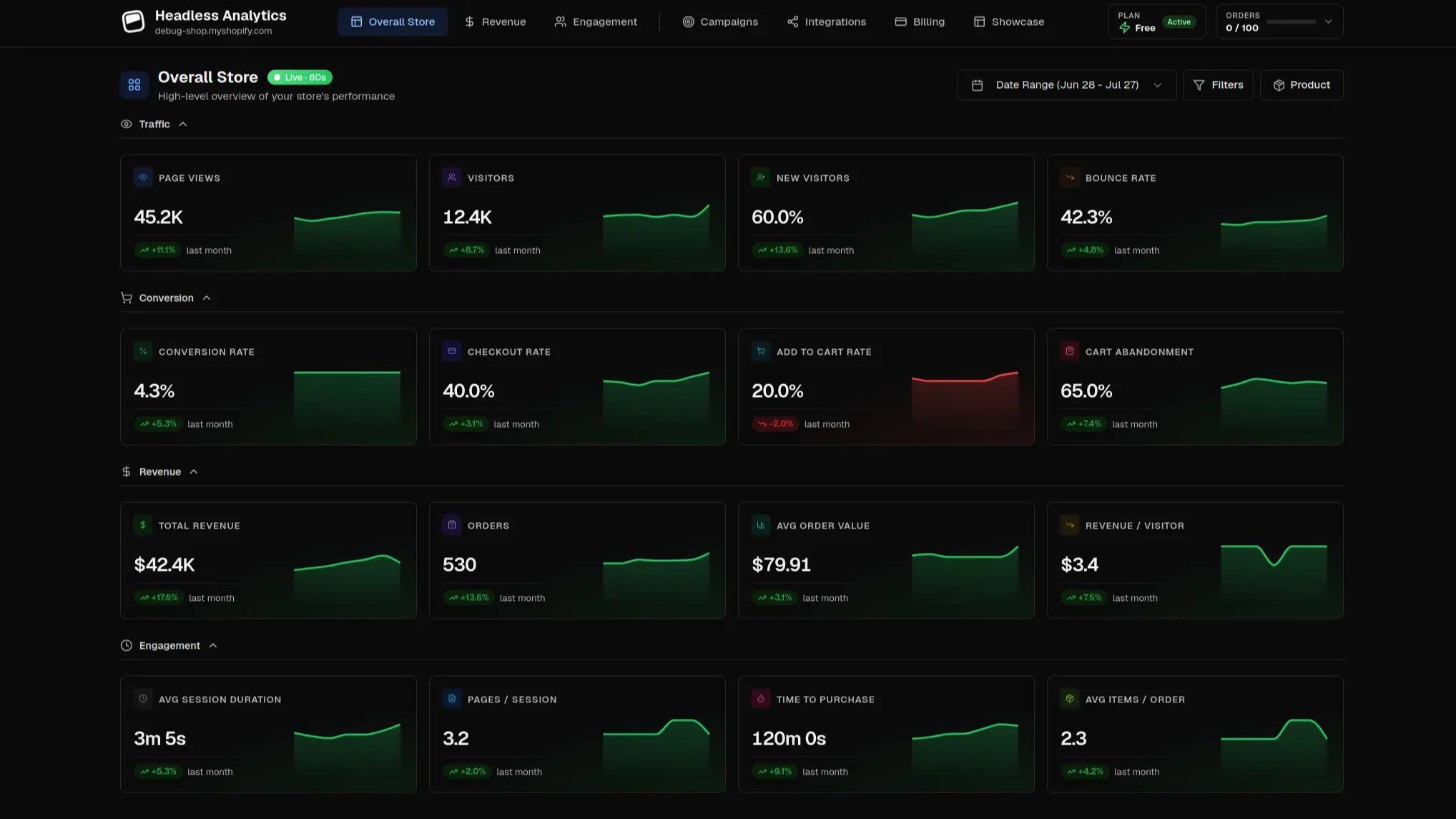

Dashboard Preview

YOU ARE
FLYING BLIND.

Your pixel is broken. Your cookies are expiring. Your decisions are guesses.

PageViewOK
AddToCartBLOCKED
PurchaseBLOCKED
THE PIXEL PROBLEM

Safari is killing your ROAS.

ITP blocks your browser pixel, causing Meta to miss critical conversions.

Shopify
$42,891
Headless
$42,891
Session Depth4.2
Scroll Rate68%
Return Freq2.8x
Time on Site3:42
+ 35 more metrics
THE ANALYTICS GAP

Shopify dashboard is a lie.

Dashboards show what happened, but never why. 39 metrics explain exactly how customers buy.

Safari · 7dHeadless · 2yr
1st click
47d later
THE ATTRIBUTION MESS

Your UTM cookies burn fast.

Safari kills cookies in days. We extend your attribution from 7 days to 2 years.

Three steps to clarity.

No complex setup. No coding required. Just clean data.

Step 01

Install the App

One-click installation. The pixel activates itself instantly and starts capturing raw data that Safari usually blocks.

Step 02

Connect Meta CAPI

Link your Meta account in seconds. We send clean, server-side data directly to your Ads Manager for maximum matching.

Step 03

Watch the Data Flow

Give it some time. Your attribution fixes itself and all 39 revenue and engagement metrics start populating your dashboard.

Built for performance stores.

The data layer Shopify never gave you.

Server Logs
[200]POST /capi/event
[OK]Purchase_Verified
[ID]_fbp.283.192...
Signal Match9.2+

Server-side tracking pixel

Bypass browser restrictions entirely. We capture data at the server level, keeping signal reliability above 90%.

Standard Pixel42% Match
Headless90%+ Match

Go from 20-40% to 90%+ accuracy

First-party tracking and server-side data enrichment deliver market-leading accuracy for your store.

Meta

Meta CAPI + CNAME Masking

First-party data collection that Meta loves. CNAME masking ensures your tracking remains invisible to ad blockers.

Bulletproof UTM

Effortlessly track customer activity without relying on fragile UTM parameters that get stripped or lost.

?utm_source=fb...
?id=82k9x2...

Own your data history

90-day retention on free plans, up to unlimited on higher tiers. Stop losing your attribution history every week.

7 DAYS
UNLIMITED

MEET YOUR
AI ANALYST.

Don't just track your data. Talk to it.

AI
Headless
Your AI analyst
118 cr

How did last week go?

Solid week — here's the shape of it.

Headline: 12,450 visitors → 530 orders → $42,350 revenue. Conversion held at 4.26% (−3.4% vs. prior period — nothing alarming).

Working: Vintage Jeans are carrying the catalog — $13,760 over 172 orders at 5.1% CVR. That's your hero product. Google is your engine — 4,200 sessions, and it converts where Facebook doesn't.

Watch: Add-to-cart is soft at 20% (−4.2% WoW). Mobile is 57% of traffic but bounces at 46% on product pages — PDP speed on phones is my first suspect. Cart abandonment sits at 65%; a 1-hour recovery email clawing back just 8% is roughly $8,400 in parked checkouts.

Want me to break down the mobile bounce story, or package this as a PDF?

Queried analytics — last 7 daysPulled traffic sources
Normal

Drop screenshots

Paste any chart or report. Get the why behind the spike.

Knows your store

Every chat builds memory of your campaigns, goals, and habits.

Keeps you honest

Set reminders on your metrics — get nudged before things slip.

Dominic, founder of Headless

Dominic

Founder • Eastern Czechia

Why I built this

I was the dev behind a headless Shopify store. We had custom engagement metrics, bulletproof CAPI, and CNAME masking. It worked beautifully.

Then we switched to native Shopify. Standard Meta pixel. Overnight - no engagement data. No CNAME. No CAPI. Just blind tracking and a conversion rate we couldn't trust.

So I built this and named this Headless, because that's exactly what I gave up to get here.

Simple, transparent pricing.

Choose the plan that fits your store's volume. Scale as you grow.

Starter

$0/month

Essential tracking for new stores.

500 AI Credits /mo
39 Core Revenue Metrics
Up to 100 Orders /mo
Meta CAPI Integration
90-Day Data History
Recommended

Growth

$24/month

Built for scaling Shopify brands.

7,000 AI Credits /mo
Up to 800 Orders /mo
2-Year Data Retention
PDF Exports
Klaviyo Integration
Best Value

Pro

$49/month

For high-volume performance stores.

15,000 AI Credits /mo
Up to 2,500 Orders /mo
Unlimited Data Retention
Custom CNAME Masking
Priority Support
Frequently asked

Questions about server-side tracking.

Everything Shopify merchants ask before switching from the standard pixel to Headless.

Meta Conversions API (CAPI) is a server-side channel that sends conversion events from your server directly to Meta, bypassing browser-based tracking. You need it for Shopify because the standard Meta pixel alone typically matches only 20–40% of conversions — Safari ITP and ad blockers strip first-party cookies within days. Headless pairs CAPI with first-party data enrichment to lift match scores out of the 20–40% range and into the 90%+ range, which directly improves Meta's optimization and your reported ROAS.

In most cases your ROAS hasn't actually dropped — your attribution has. Safari ITP caps browser-pixel cookies at 7 days, ad blockers strip ~30% of pixel events, and iOS 17+ removed several client-side identifiers. Meta then optimizes on incomplete data and shifts budget away from campaigns that were actually profitable. Headless restores server-side, first-party tracking with 2-year data retention, so Meta's algorithm sees the full conversion picture again.

The Meta pixel runs JavaScript in the customer's browser and fires events client-side, which is vulnerable to ITP, ad blockers, and iOS restrictions. Server-side tracking fires events from your server to Meta's Conversions API, so it is not blocked by the browser, not stripped by ad blockers, and not limited by cookie lifetimes. Headless is built server-side end-to-end, which is why signal match scores stay high across the events that actually decide a campaign.

Safari's Intelligent Tracking Prevention (ITP) caps first-party cookies set via JavaScript at 7 days and known trackers at 24 hours. For Shopify stores running paid Meta ads, this means most returning-customer conversions never get attributed back to the original ad click — Meta's algorithm then underweights your best-performing campaigns. Server-side CAPI is the standard fix: the event leaves your server, not the browser, so ITP never touches it.

CNAME masking hosts your tracking pixel on a first-party subdomain (e.g. `track.yourstore.com` instead of `facebook.com/tr`). Ad blockers that maintain blocklists of third-party tracking domains cannot easily block a first-party subdomain, so the same pixel events that were being dropped start firing again. Combined with server-side CAPI, CNAME masking is one of the highest-ROI changes you can make to a Shopify tracking stack.

Independent benchmarks place the stock Shopify Meta pixel at roughly 20–40% conversion match in 2026, with significant variance by traffic source and device mix. The signal loss compounds: a campaign that Meta's algorithm thinks is unprofitable gets deprioritized, even if it was actually your best. Headless' server-side pipeline with first-party data enrichment and CNAME masking is what moves a store out of that range — read your own Event Match Quality in Events Manager to see where you land, rather than trusting a vendor's number.

The strongest Shopify CAPI solutions in 2026 share a few traits: native server-side ingestion, first-party data enrichment (email, phone, external_id), CNAME masking, and deduplication against the browser pixel. Headless is purpose-built for this stack on Shopify, with one-click install, 39 revenue and engagement metrics, and tiered plans from $0 to $49/mo. Heavier attribution suites like Triple Whale and Northbeam cover more channels but cost 5–10× more.

First-party data — emails, phone numbers, loyalty IDs, order histories collected with consent — is hashed and attached to each CAPI event. Meta then matches conversions to actual people instead of anonymous browser sessions, which raises event match quality from the 20–40% pixel range into the 90%+ range. Headless enriches every event with whatever first-party identifiers you already collect at checkout, so Meta's optimization can spend on the audiences that actually convert.

For a single-store Shopify brand that runs Meta only, has clean traffic, and does not need reporting beyond Ads Manager, Meta's free 1-click Conversions API gateway is genuinely enough — it costs nothing and removes the developer dependency that made server-side tracking expensive before. It became broadly available in April 2026 and it reset the price of basic server-side delivery to $0. The honest limit is what it does not do: it forwards what your pixel already saw. It does not enrich events with first-party identifiers, does not deduplicate across surfaces, does not filter bot and invalid traffic, and gives you no analytics layer of its own. You need a paid tool when any of these are true: your Event Match Quality sits below roughly 8.0 and you want it higher; you run more than one store, ad account or platform; you need consent enforcement before an event reaches Meta; you need bot and invalid-traffic filtering, because a bot that scores well on Event Match Quality still damages Smart Bidding; you need 90-day-plus attribution history; or you need to know which campaigns profit after ad spend, not just which ones report ROAS. If none of those apply, use the free gateway and keep the $0. Headless starts at $0 for the same reason — the free tier exists for stores that only need the delivery layer.

Work in this order, because each step depends on the one before it. First, deduplicate: send the same event from browser and server with a shared event ID so Meta keeps one copy instead of counting it twice. Second, enrich: attach hashed email, phone and external_id on every server event — match quality is a function of how many identifiers Meta can match on, and this is the single largest lever. Third, send from your own subdomain with CNAME masking, so ad blockers that maintain third-party blocklists cannot drop the events before they leave the browser. Fourth, check for invalid traffic: a bot that scores well on Event Match Quality still damages Smart Bidding, so filter rather than maximize the score. Fifth, verify in Events Manager that browser and server events both arrive for the same action source. A store that skips deduplication and goes straight to enrichment usually sees match quality rise and reported ROAS fall, because double-counted conversions look like a sudden profitability problem to Meta's algorithm.